Bold Predictions for 2026…

Let me establish upfront that I am no great prognosticator. As a matter of fact, as best I can remember, I’ve never made a list of predictions before in my life. It is presumptuous, and that is one thing a follower of Jesus Christ should never be. I’m reminded of what the Apostle James wrote to the early Church:

1Now listen, you who say, “Today or tomorrow we will go to this or that city, spend a year there, carry on business and make money.” 14 Why, you do not even know what will happen tomorrow. What is your life? You are a mist that appears for a little while and then vanishes. 15 Instead, you ought to say, “If it is the Lord’s will, we will live and do this or that.” 16 As it is, you boast in your arrogant schemes. All such boasting is evil.17 If anyone, then, knows the good they ought to do and doesn’t do it, it is sin for them. James 4:13-17 (NIV)

Image created using AI

We can’t predict the next hour with great certainty much less the next year, so it is a bit bold to attempt a list of predictions as we roll into this new year.

So, why embark on such a fool’s task? Well, one, I’m probably a fool, but two, because I have followed the Christian landscape fairly closely over the past few years and I see some things on the horizon that I’m concerned about. Perhaps, then, they are not so much predictions as they are points of interest to watch or look for as the year progesess. I share them so that you might watch with me.

So, without further ado, here are FIVE BOLD PREDICTIONS CONCERNING THE CHURCH IN 2026 (in no particular order):

5) The United Methodist Church will continue to decline.

I hope this doesn’t sound like sour grapes, nor do I wish you to think I relish in this prediction, but this one really is a no-brainer without the direct intervention of the Holy Spirit. The trajectory over the past few years is relatively clear–it’s down and to the right.

That trajectory was hastened by the “disaffiliation” process the denomination instituted a few years ago. Statistics for my old Annual Conference shows a total membership of 53,085 in 2024 (the last year available) and total weekly attendance of 22,281. My final year as a member of the Annual Conference (2019) showed 105,992 membership/104,501 attendance. I’ll grant that Covid occurred in the interim, but so did disaffiliation. Between the two, the Annual Conference saw severe decline.

The number of congregations constituting the Annual Conference also saw a significant decrease during that same period. The denominational statistical website (UMData.org) lists 267 congregations in the Louisiana Annual Conference at the close of 2024. Likewise, at the end of 2019, there were 486 congregations.

By my math (which ain’t great, by the way), that equates to approximately a 50% drop in membership, an over 80% drop in attendance, and a 45% drop in the number of congregations. None of those are encouraging numbers.

According to Google, between 7,600 – 7,900 congregations departed the denomination since 2019. That’s over 25% of all the congregations that once constituted the United Methodist Church. The numbers also don’t tell us how many members were “quiet departures”–meaning they simply left their congregations without fanfare.

Hey? This isn’t new information. The United Methodist Church was in decline pre-Covid and pre-disaffiliation. Both only hastened the process. Long before Covid or disaffiliation, economist Don House warned UMC leadership that collapse was inevitable.

Honestly, the UMC is only going the way of all mainline denominations. The Pew Research Center has catalogued this decline for years. Count the decline to whatever reason you will (there are many and it is complex), failing the Holy Spirit’s intervention, this prediction is rather easy to make.

4) Large churches will get larger and small churches will get smaller.

This prediction, too, is a safe one. Researchers say that overall church attendance is down while megachurch (over 2,000 people in attendance) is up 10%. Here’s what’s happening: Many believers are leaving the small congregation and migrating to the large one.

It’s another example of “consumer” Christianity. For better or worse, it’s a fact and we need to acknowledge it. Church members migrate to the larger churches in favor of programming, activities and events that smaller congregations can’t or don’t have. Also, many people embrace the anonymity that comes by being a part of a large church. One can slip in and slip out un-noticed, and if they leave the congregation no one notices.

Yup, in a megachurch, one never has to look another person in the eye. In a small church, a newcomer may have to navigate (or hope to avoid) every person in the congregation. Talk about no longer living in a culture where that possibility is comfortable is understatement.

Additionally, smaller congregations are “graying,” meaning its members are getting older. When we get older, we don’t attend as often. Illness and mobility limit our participation. It’s a fact of life. Smaller congregations are finding it difficult to replace those graying members. The reasons are, again, diverse and complicated. Failing the Holy Spirit’s intervention, this prediction, too, is an easy one to make.

3) Artificial Intelligence will become more prominent in Christian worship.

I’m really going out on a limb with these predictions, aren’t I? Though it is an easy prediction to make, this one concerns me more than the rest. Why?

The use of Artificial intelligence removes the human element and removing the human element from Christian worship distorts the reality of Christian worship.

Consider this: recently, the number 1 song in Christian worship was written by AI and performed by an AI generated personality (see the story here). There is no Holy Spirit engagement, no human struggle, no human/Divine interaction, no witness/testimony. Each of these are necessary in authentic worship of the Lord.

Yes, I know. The integration of AI is just another use of “technology” in the worship experience, but is it a good one? How about AI writing your pastor’s sermons? Good idea? I don’t think so!

I’ll confess. I have utilized AI in my sermon preparation. It is a great tool to use for research. When I left full-time vocational ministry, I sold (or gave away) the lion’s share of my library. AI has kept me from having to repurchase volumes and volumes of commentaries, dictionaries and the like now that I’m serving bivocationally. As a tool, AI is great. As a replacement for prayer, study and preparation, not so much.

Honestly, AI can probably write a better sermon than I can. I tried it one time (read the results here). It was a very good sermon. No, I did not preach it.

AI can read all the Bible commentaries in the world in seconds, categorize their meanings and spit out a 2,000 word sermon in under a minute. What pastor wouldn’t love to free up 8 – 10 (or more) hours per week to devote to other responsibilities? But, using AI to write one’s sermon is equally as bad as a pastor plagiarizing another pastor’s sermon (which happens far too often, anyway). Then again, wasn’t it Mark Twain who said, “The key to originality is the ability to conceal one’s sources.” Ouch!

Let’s not even mention the impact that AI is going to have on the use of resources that could otherwise be used to promote human flourishing. Do you know how much energy (electricity) these AI data centers are going to need? WE ARE NOT PREPARED FOR THE FULLY FUNCTIONING AI EXPERIENCE!

AI will be the death of the human race. That’s a far more bold prediction than predicting it will be used more in Christian worship. Pastors and lay persons need to seriously assess the use of AI in the body of Christ. We need the Holy Spirit’s intervention if we are to be faithful stewards of this transformative technology.

2) Christian persecution will grow in 2026, especially in the United States.

It was November of last year that saw gunmen enter St. Mary’s Catholic School in Nigeria kidnapping over 300 students and a dozen teachers. Only a few days earlier, attackers targeted a church in Nigeria, killing two and injuring 38 more (story here). These types of attacks are increasing in frequency, so to predict more in 2026 is yet another easy call (see how bold I am?).

For a sampling of areas of persecution, see the Wikipedia statement below:

“According to the United States Commission on International Religious Freedom‘s 2020 report, Christians in BurmaChinaEritreaIndiaIranNigeriaNorth KoreaPakistanRussiaSaudi ArabiaSyria, and Vietnam are persecuted; these countries are labelled “countries of particular concern” by the United States Department of State, because of their governments’ engagement in, or toleration of, “severe violations of religious freedom”.[15]: 2  The same report recommends that AfghanistanAlgeriaAzerbaijanBahrain, the Central African RepublicCubaEgyptIndonesiaIraqKazakhstanMalaysiaSudan, and Turkey constitute the US State Department’s “special watchlist” of countries in which the government allows or engages in “severe violations of religious freedom“.[15]: 2 

“Much of the persecution of Christians in recent times is perpetrated by non-state actors which are labelled “entities of particular concern” by the US State Department, including the Islamist groups Boko Haram in Nigeria, the Houthi movement in Yemen, the Islamic State of Iraq and the Levant – Khorasan Province in Pakistanal-Shabaab in Somalia, the Taliban in Afghanistan, the Islamic State as well as the United Wa State Army and participants in the Kachin conflict in Myanmar.[15]: 2 

I know…Wikipedia, right?

A little more bold prediction is for the type of persecution that is happening around the world is going to increase in the United States. What some call persecution, others call inconvenience. I see inconvenience soon becoming persecution with the increasing secularization of western culture, and the encroachment of Islamic influence and socialist/communist polices and politicians in our nation.

Examples of the “creeping” nature of this persecution are when churches were forced to close in 2020 while casinos, bars and strip clubs remained open, and the recent legal suits against Christian business owners who refused to serve LGBT+ customers. Okay, so I would have made the cake, but I shouldn’t be forced to or made to pay if I refuse. Need I even mention the targeting by the IRS of Christian non-profits?

Of all of my “bold” predictions, this is the one that is least likely to come to pass (at least I hope it is), but it is, nonetheless, a legitimate possibility.

And for my final prediction…

1) Jesus will continue to save the lost.

Talk about the no-brainer of no-brainers. The Holy Spirit will be active in the Church to make a difference in people’s lives and bring them to a saving relationship with Jesus Christ.

Our task, as disciples, is to live faithful, obedient and holy lives so that the Holy Spirit might actually use us in that process.

Evangelism is a cornerstone of the growth of the Kingdom of God and will be integral to the work the Holy Spirit will do if predictions 4 & 5 are to be avoided in 2026 and beyond. Unfortunately, I am afraid evangelism is no longer in the theological wheelhouse of the mainline church, or in many small congregations (regardless of affiliation).

Let us be diligent in sharing the Gospel because we know the Lord Jesus Christ is still in the saving business. His grace is enough.

I’m 100% certain of this prediction because no liberal, mainline theological drift, no congregational decline, no technology and no persecution can change the power of Jesus Christ to save a life. He is the One who builds His Church. He is the One who transforms lives. The Church, that invisible, eternal body of Christ will continue to grow and make a difference in this old world. How do I know? Because Jesus Himself said so:

And I say also unto thee, ‘That thou art Peter, and upon this rock I will build my church; and the gates of hell shall not prevail against it’.” Matthew 16:18 (KJV)

That, my friends, is good news, indeed!

So, none of my predictions were really that bold after all. Well, anyway, here’s to a blessed 2026.

Until next time, keep looking up…
When the “Smoke” Clears…

I spend a lot of time looking through my windshield. To pass the time, I listen to a lot of podcasts (and I mean a lot!). I came across one recently entitled “The Roys Report” that peeked my interest, so I gave it a listen.

I came across The Roys Report months ago when I was following news of the fall of several prominent megachurch pastors. I won’t say I’ve been a regular listener of the podcast, but if one pops up that sounds interesting, I give it a listen.

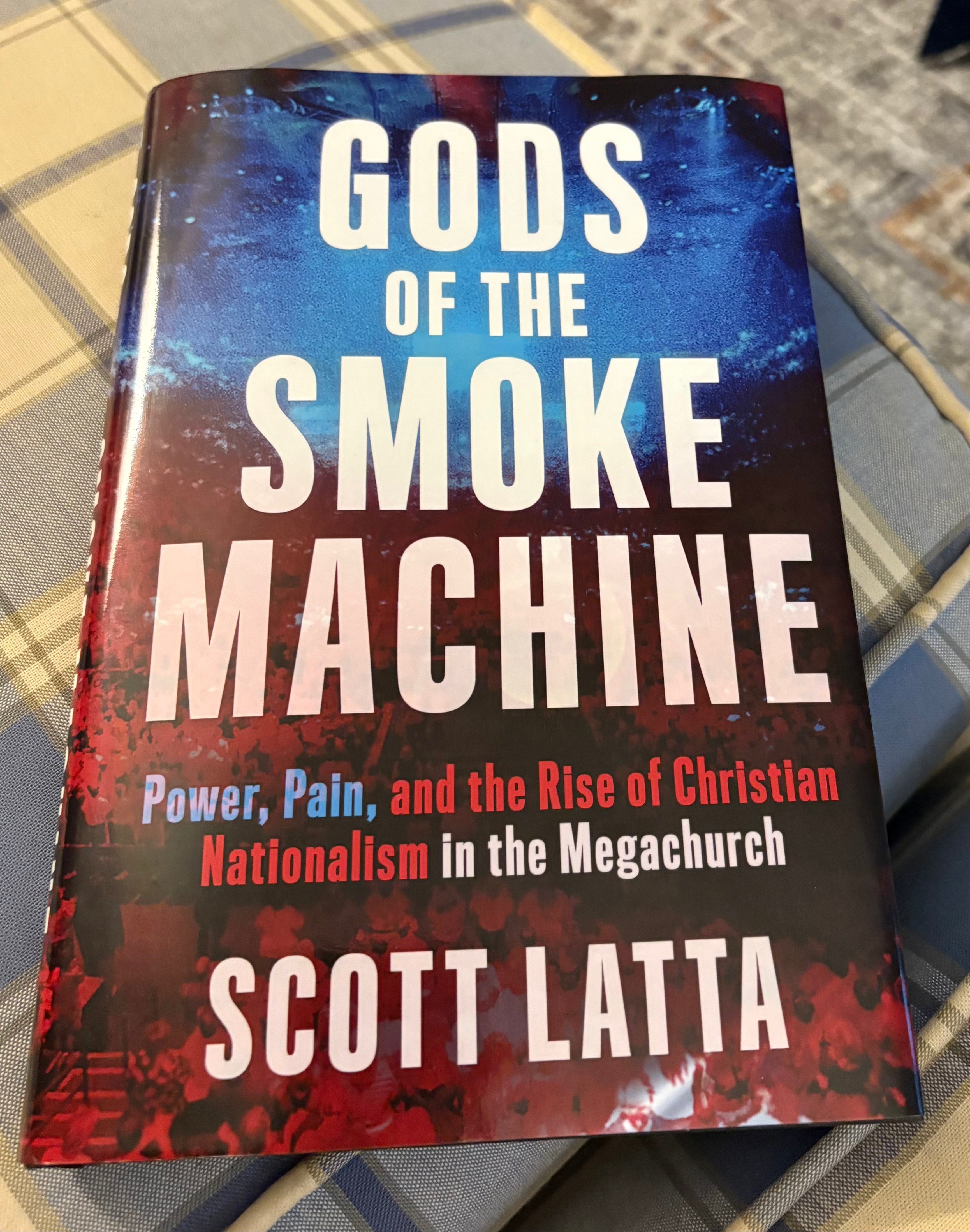
This particular podcast was an interview with the author of a new book entitled “Gods of the Smoke Machine: Power, Pain and the Rise of Christian Nationalism in the Megachurch” by Scott Latta. I found the conversation compelling so I ordered the book. What follows are my reflections after having finished reading it (I suppose that makes it a book review).

Okay, so the book was a page-turner for me. It is well-written. Latta’s writing style is quite engaging and easy to read, and I would recommend this book to pastors and church leaders who are on the front-lines of ministry in contemporary culture.

Hard Conversations

There are few topics more difficult for Christians to talk about than the failures of the church. I love the church. I’ve been formed by it, baptized in it, comforted and corrected by it. Yet, my own history and experience have taught me that love does not require blindness. Sometimes love requires truth-telling.

Latta attempts to shine light on a truth that many folks find difficult to talk about. Nevertheless, it is a conversation worth having. Reading the book caused me to ask the question: Are we worshiping God, or have we learned to worship the machinery built in His name?

Let me confess that Latta and I are not of the same “tribe.” He is one who is in the process of “deconstructing” his faith (or has completed the process–I’m not really sure after reading the book).

This is not a review of the somewhat new and novel idea of “deconstruction” of one’s faith, but if you’re unfamiliar with the term, you can Goggle it to learn more. Simply put, it is exactly what comes to your mind when you hear the phrase “deconstructing one’s faith.”

Though not of the same tribe, I found some value in reading the work. It does us good to get out of our echo chambers to hear other voices. They cause us to think and possibly find some common ground upon which we might build a relationship.

When Growth Becomes the Measure of Faithfulness

Latta reflects on the rise of the modern megachurch and the ways large congregations have learned to thrive even as church participation in America declines. He points out in the introduction that overall church attendance has fallen by about half over the past 25 years. Yet, while overall attendance has fallen, attendance in the megachurch (weekly attendance greater than 2,000 people) has increased by 10% between 2015 and 2020.

Yes, as Latta points out, the pie is getting smaller, but the megachurch’s piece has gotten larger.

Growth itself, of course, is not the problem. Scripture celebrates growth when it flows from faithfulness. But Latta raises a necessary concern: when numerical success, branding, and influence become the primary measures of God’s blessing, something essential is at risk of being lost.

From a pastoral perspective, this is not simply a critique of church size or style. It is a call to remember that the church is not a product to be managed but a body to be shepherded. Efficiency and excellence can serve the gospel—but they can never replace presence, humility, or accountability.

Listening to the Wounded

Perhaps the most sobering parts of the book are the voices of those who were hurt within church systems that should have protected them. Latta shares stories of people who experienced spiritual manipulation, silencing, and abuse, and who found that institutional loyalty often outweighed compassion, truth and accountability.

These stories deserve our prayerful attention. My pastor’s heart reminds me that the credibility of the church is not measured by attendance numbers or production quality, but by how we treat “the least of these”—especially when listening is inconvenient or costly. Repentance, not reputation management, is the way of Christ.

Of course, my more pragmatic (or cynical) self wants to say, “There are two sides to every story.” We only hear one side of the story in Latta’s book. In fairness, according to Latta, churches and pastors were given opportunity to comment, but most did not respond.

Faith, Power, and Allegiance

Latta also explores the uneasy relationship between some megachurches and political power, particularly the blending of Christian language with nationalist ideology. Viewed through my pastoral lens, my concern is not about political disagreement, but about ultimate allegiance. When loyalty to leaders, movements, or ideologies begins to eclipse allegiance to Christ, the church’s witness becomes distorted.

The church has always lived in tension with worldly power. The danger comes when that tension disappears—when the cross is replaced by the quest for influence, and when winning matters more than loving.

A Call to Self-Examination, Not Cynicism

While Gods of the Smoke Machine is clearly critical of the state of the American megachurch, I think Latta painted with a very broad brush. The focus of the book really is upon a very few megachurches and their pastors. He says very little about the majority of churches (there are approximately 1,800 megachurches in the U.S.) and pastors who are faithful to the Gospel and do their best to love one another.

Not to despair, though. The book became for me an invitation to self-examination. Not every church is a megachurch, and not every leader is compromised—but every Christian community must regularly ask hard questions about power, transparency, faithfulness and yes, accountability (there’s that word again).

This book challenges pastors, elders, and congregants alike to consider whether our structures reflect the character of Christ or simply the efficiencies of modern institutions. It urges us to remember that the Spirit of God is not manufactured by lighting cues, smoke machines or emotional crescendos, but is present where there is truth, repentance, and love (oh, and accountability).

Reading with Hope

Ultimately, Gods of the Smoke Machine is a book best read slowly, prayerfully, and with humility. It may stir grief, anger, or recognition. But it can also stir hope—hope that the church can still choose a better way, and that reform is possible when the people of God are willing to listen, repent, and return to the simplicity of the gospel.

For pastors, church leaders, and thoughtful Christians, this book offers an opportunity not to abandon the church, but to love it more faithfully—by seeking the health of Christ’s body rather than the success of its machinery.

There is a bit of the prophetic in the work. Unfortunately (or fortunately?), that prophetic word is coming from one outside the church (well, one who left the church). I don’t know if that makes him an outside insider or an inside outsider. Either way, it will do we leaders well to listen to that prophetic word and take it seriously.

Until next time, keep looking up…

Bethlehem Faith…

I’ve been reading and praying over Micah’s prophecy this Advent season:

“But you, Bethlehem Ephrathah,
    though you are small among the clans of Judah,
out of you will come for me
    one who will be ruler over Israel,
whose origins are from of old,
    from ancient times.”

Therefore Israel will be abandoned
    until the time when she who is in labor bears a son,
and the rest of his brothers return
    to join the Israelites.

He will stand and shepherd his flock
    in the strength of the Lord,
    in the majesty of the name of the Lord his God.
And they will live securely, for then his greatness
    will reach to the ends of the earth.

And he will be our peace…

I don’t know whether to call it divine providence or serendipity that it so happened as Advent is drawing to a close that this passage is part of my “Bible in a Year” reading plan. I shouldn’t be surprised because Micah’s prophecy lies near the end of the Old Testament and the year is almost gone, so..

I still prefer to think it divine providence, though.

God in the Small Places

Bethlehem seems like such an odd place. It really wasn’t known for much of anything in those days, so much so that Micah even says it was “small among the clans of Judah.” It’s that idea of small that has captured my attention this Advent.

When I think of Bethlehem, I can’t help but think of Eros, LA, that place I served my first full-time appointment in ministry. There wasn’t much in Eros (still isn’t) in those days. Not a stop light. Stop light? There wasn’t (isn’t) even a flashing caution light. Not many people either. A couple of hundred as best I recall. Simply a little country town with little significance. That was Bethlehem, too.

Bethlehem reminds me that God chooses to do His greatest work in the most unlikely places. The “small” places of life.

We live in a world obsessed with size, speed, power and recognition–a world where young people want to be known as “influencers” and we all want more “followers,” and we want to grow our “platform.” Bethlehem reminds me that God will do His deepest work in quiet obedience, unseen prayers and simple acts of kindness that only heaven sees.

Presence over Power

Bethlehem also reminds me that peace doesn’t come from power–it comes from presence. Micah says, “And He will be our peace…”

We live in a world where anxiety runs rampant. I am reminded that peace is not the absence of conflict but the presence of Christ. We can live in Bethlehem-sized circumstances (small paycheck, small church, small town, small family, small circle of friends), but we can have peace that is vast and deep when Jesus reigns in our hearts.

Bethlehem reminds me, too, that the humble road is still the holy road. Humility is the soil where redemption grows. I am reminded of what James said–“God resists the proud but gives grace to the humble (James 4:6).

In every generation, He looks for people willing to say, “Lord, I am small but You are great. Use me however you will.” When we accept our smallness, God’s greatness shines through.

Living in Bethlehem

Bethlehem, this small little hamlet tucked deep in the heart of Judah, was part of God’s unfolding plan. Granted it was just one chapter, but what an important chapter it was. Bethlehem reminds me that the Church is the continuation of what began there. Just as Jesus was born in Bethlehem through Mary, Jesus is now revealed through us, His body. We are called to be spiritual Bethlehems–places where the presence of Christ is made known to the world.

I like to believe the presence of Christ can be made known through the small church. The church I pastor is a small church, indeed, but I believe the power of God that was present in Bethlehem will be present in us if we live in humble, faithful obedience to the Lord Jesus Christ. I look forward to seeing the great things He will do with our little church.

The Bread of Life

Finally, Bethlehem reminds me that the world still needs the “bread of Life (John 6: 35). Bethlehem means “house of bread.” Out of the house of bread comes the bread of life. Our world is starving—not for carbohydrates, but for meaning, peace, and truth.

Every Christian today bears the calling to feed the hungry hearts around them with the Bread of Life. Whether you’re a teacher, mechanic, pastor, or parent, your life becomes a Bethlehem when Christ uses you to nourish others with His love and truth.

Bethlehem isn’t just a quaint Christmas scene, but rather a reminder that God’s unstoppable, unshakable Kingdom comes in un-noticed ways and un-noticed places. Bethlehem was the first stop on the way to the cross. Bethlehem was the first stop on the way to the resurrection. We can’t get to glory without Bethlehem.

It is in Bethlehem that the small becomes sacred and the ordinary becomes eternal. If your faith feels small this Christmas I have one word for you–Bethlehem! Jesus Christ is still in the business of entering dark nights with shining light and bringing peace to all who welcome Him.

Merry Christmas everyone!

Until next time, keep looking up…

A Methodist Firing…

Don’t Fire Your Preacher the Wrong Way

Well, it happened. I knew it would eventually. What happened? A Methodist preacher got fired. We’re not accustomed to that.

See? What used to happen before the big “split” in the United Methodist Church was a pastor got “moved” whenever a congregation wanted a change in pastoral leadership. Every year, the Staff-Parish Relations Committee would meet to do an evaluation of the pastor.

Generally, at the end of the evaluation, there were two options: move, or stay. If the Committee (congregation) wanted the pastor to return, they checked stay. If they wanted to “fire” the pastor, they checked move. That’s the simplified version, but basically the process.

Pastors filled out an evaluation, too. It was basically the same process in reverse. It was a means of communicating to the denominational higher ups whether the pastor wanted to stay at the congregation, move to a new one, or was open to either prospect (meaning “I’d take a better appointment”).

Well, for those Methodist pastors (including myself) who left the United Methodist Church, times have changed. Especially for those pastors serving congregations who remained independent. We can get fired–just like our colleagues in most Baptist denominations (and a few others).

I had a friend and former colleague who “resigned” from his congregation recently. He was “asked” to resign (which is code for “resign or we’re going to take a vote and fire you”). Mind you, this was not a pastor who had only served the congregation for a short time and it just didn’t work out. The pastor had served them for over a decade, so he wasn’t an unknown quantity.

I don’t know all the specifics of the separation (and I don’t want to know), and no, I’m not going to name names or point fingers. This isn’t a blog about that. This is a blog about this brave new world many Methodists are living in, and is offered as an encouragement for independent Methodist congregations to act in Christian ways when they feel like it’s time for a change in pastoral leadership.

I’m not saying this congregation acted in an un-Christian way, though from some conversations I’ve had with folks in the congregation I’ve surmised it was not handled in a healthy way for either the pastor/family or the congregation. This is not about that. It is about being faithful in the inevitable event that a pastoral change is necessary.

As I’ve reflected on and prayed about my friend’s situation, I’ve hit upon some advice I’d like to share with Methodist congregations as they live in their new reality.

Be Transparent

First, be transparent (or as transparent as the situation allows). When a pastor “resigns” or is unexpectedly fired from his/her position, it raises a lot of questions for the congregation. Those questions, when they go unanswered or unaddressed, can easily give fuel to gossip in the congregation. That gossip can also easily damage the pastor’s reputation.

Can you hear the gossip now? “Oh, what did he/she do?”

“He must have stolen money!”

“There must have been a moral failure.”

“Who did he/she offend?”

Transparency quells the gossip–well, mostly. Gossips are going to gossip, but leadership owes the congregation and the pastor the truth.

If leadership wants to fire the pastor, own it. Don’t put the onus on the pastor as if it was his/her decision. And, don’t put in place any non-disclosure agreements (unless the law necessitates it). Don’t say to the pastor, “We’ll pay you a severance if you don’t say anything to anyone.” That’s just more fuel on the fire.

Be Generous

Speaking of severance, that brings me to the second point I want to make: Be generous to the pastor and the pastor’s family, regardless of the circumstances of the separation. Three to six months of salary should be offered to the departing pastor.

Why? Well, consider everything the pastor loses when he/she loses their position. First, they (generally) lose their home. If the church owns a parsonage, the pastor and family have to move. They may even have to purchase a new home.

Even if they already own their own home, the likelihood is they will need to sell it and move to a new community because full-time ministry positions don’t grow on trees. Seriously, how many opportunities for vocational Methodist ministers exist in your town? That’s what I figured.

It will take a minimum of three to six months for the pastor to find a new position, move to a new community and settle in new environs. Congregations need to consider this when choosing to fire a pastor. If the congregation (or congregational leadership) made the decision to transition to new leadership, count the cost and own it–every stinking bit of it. It’s the Christian thing to do.

Secondly, the pastor and his/her family loses their friendship network. Most of a clergy’s friendship network is within the congregation. In one fell swoop, those relationships are gone. They also lose their church family, too. The children (if there are any) lose their schools and their friends. The spouse also has to find a new job.

Think about this: You’re a teacher and you lose your position. You still have your friendship network. You still have your church home. You (most likely) still have your home. For the pastor and his/her family? All three are gone in one decision by a church board or congregation.

Every congregation initiating a move should graciously provide counseling as part of a severance package and job search assistance to the pastor/family. I’m reminded of what the Apostle John wrote in 1 John 3: 17–“If someone has enough money to live well and sees a brother or sister in need but shows no compassion—how can God’s love be in that person?

Be generous, my friends. It’s the Christian thing to do!

Be Patient

Perhaps I should have started with this advice–be patient. What do I mean by patient? Well, unless the leadership has worked with the pastor through a remediation plan before they ever come to a “firing” decision, well, you’ve already done it wrong.

When problems arise (and they will), the first step should be for the person designated by the church by-laws (Discipline) to sit down with the pastor to provide a clear explanation of the issues at hand. There should always be a process in place to work with the pastor to address any issues the congregation may be facing.

That process may include counseling, continuing education or even arbitration, and there must be (let me stress MUST) a process to continually re-evaluate the situation. It’s simply a matter of justice, folks.

Don’t blind-side your pastor with a list of complaints (especially anonymous ones) and then say, “We think it’s time for a change.” That is the most unjust thing that can ever happen. If your congregation’s “firing” happens like that, well, your congregation has deeper issues that a new pastor isn’t going to change.

Sit down. Develop a plan. Work the plan…for a minimum of twelve months. Communication is key. Conflict avoidance only heightens the conflict. Working through a remediation plan is the most gracious and healing way to deal with issues involving pastoral leadership.

Granted, there will be some pastors who don’t respond well to remediation. Believe me. When I was a District Superintendent, I encountered some of those pastors. I’ll share with you what I recently shared with my congregation: Don’t let someone else’s misbehavior be an excuse for your misbehavior.

Honestly, if a pastor isn’t open to working through and responding positively to a process of conflict resolution, he/she will make the decision to initiate a transition. Most pastors don’t want to move. Most pastors are serving their congregations in a self-sacrificial way. Congregations need to repay that sacrifice with transparency, generosity and patience.

A Word to Pastors

Let me just say a brief word to pastors who may be reading this–this advice works in reverse, too. Don’t blind-side your congregation with the news that you quit! It’s not fair to them. Seriously, if you feel the Holy Spirit’s nudging to a new season of ministry, sit down with your congregation’s leadership and be transparent. Give plenty of notice. Hey? The congregation (leadership) may even be helpful in the discernment process.

If we, as pastors, want congregations to be fair with us, we must be fair with them. After all, pastors don’t grow on trees. Leaving on short-notice brings harm to the congregation and thus, to the Body of Christ. Don’t be one of those pastors.

Just Do the Right Thing

Let me reiterate: All this advice is absent moral failure on the pastors part. The moral failure of a pastoral leader opens up a whole other can of worms. Talk about harm to a congregation and to the Body of Christ! There’s nothing that does more damage to the life and health of a congregation than a moral failure of its leader. That’s for another blog…or not!

Let me just say to congregations, don’t be one of those congregations that changes the locks to the church when the pastor is on vacation (it really happened). Trust me. That makes you like the Church of Laodicea (Revelation 3: 14 – 22). Jesus just wants to vomit you out of His mouth.

Just do the right thing. It honors Christ. It builds up the body of believers. It gives a good witness to the world.

Besides, for both pastors and congregations, the grass is rarely greener. Pastoral leadership is rarely the reason for dying congregations, and difficult congregations are rarely the reason for bad pastoral leadership.

Also, keep this in mind, congregations–pastors are in short supply. Pastors, keep this in mind–good pastoral appointments are in short supply. Especially in this new Methodist environment. It’s a new world we’re living in. Let’s navigate it with transparency, generosity and patience. We’ll all be better off in the end.

Until next time, keep looking up…

Bowing to Cultural Approval…

Six Subtle Ways We Bow to Cultural Norms

Okay, so I’ve been reflecting on Daniel 3 all week because I’m preaching on that passage today. In my prayer and reflection, I began to consider what are some of the subtle ways we believers in Jesus Christ can sometimes bow to sins that have become culturally acceptable. They’re not likely to show up in today’s message, so I thought I might share them here.

Shadrach, Meshach and Abednego

Shadrach, Meshach and Abednego (along with the prophet Daniel) were part of the Hebrew upper class that were carted off to Babylon during the Babylonian captivity. While there, they were schooled in the best Babylonian schools, and after three years were placed into King Nebuchadnezzar’s (King Neb, for short) court for service to the empire.

Hey? If you’ve been in Sunday school at all, you’ve heard the story before (read it here). King Neb builds a gaudy statue and commands the entire empire to bow down before it when they hear the music play. The music plays and everyone bows except these three Hebrews (I’m not sure where Daniel is during all this). The three get tattled on to the King who calls them to himself to give them one more chance to submit.

The three refuse in one of the most remarkable ways recorded in the Bible:

1Shadrach, Meshach, and Abed-Nego answered and said to the king, “O Nebuchadnezzar, we have no need to answer you in this matter. 17 If that is the case,our God whom we serve is able to deliver us from the burning fiery furnace, and He will deliver us from your hand, O king. 18 But if not, let it be known to you, O king, that we do not serve your gods, nor will we worship the gold image which you have set up.” (Daniel 3: 16 – 18 NKJV)

I love the “But if not…” statement of verse 18. What faith! “King Neb, even if God doesn’t deliver us, we’ll not bow down to your idol.”

The Idol in Question

Neb’s idol was a 90 foot tall gold statue. It was pretty obviously an idol. Everyone knew it was an idol and no one really cared. Babylon was filled with idols. What’s one more? Idols were culturally acceptable in those days. What’s the big deal?

That’s probably the question that was on King Neb’s mind as he confronted the three Hebrew young men. And, I have to wonder if Shadrach, Meshach and Abednego hadn’t considered it themselves. I mean, perhaps they had the philosophy that the Apostle Paul later expressed to the Corinthian Christians:

Therefore concerning the eating of things offered to idols, we know that an idol is nothing in the world, and that there is no other God but one. For even if there are so-called gods, whether in heaven or on earth (as there are many gods and many lords), yet for us there is one God, the Father, of whom are all things, and we for Him; and one Lord Jesus Christ, through whom are all things, and through whom we live. (1 Cor. 8: 4-6 NKJV)

Yup! They could have adopted that mentality, bowed down to the idol and everything would have been fine. After all, everyone else was doing it, and they weren’t actually bowing down to anything that was real, so just go along to get along.

Thank God, they didn’t bow down! They chose obedience to God over cultural influence. What an example for us!

Six Cultural “Idols”

Okay, so they’re not really idols in the strictest sense, but they are areas of cultural influence that often cause us to bow down in contrast to the clear teaching of Scripture. What are they?

1. Gossip

Gossip is one of the most common places where we bow to cultural pressure because we can disguise it as conversation, or even…wait for it…prayer concerns. There is a fine line between sharing concern and gossip.

Gossip is talking about others in a way that does not honor them or God. I’m reminded of Solomon’s wisdom in Proverbs 16: 28–“A troublemaker plants seeds of strife; gossip separates the best of friends.

When someone tries to bring gossip to us we must kindly and gently shut the door, refusing to bow to the pressure to sully someone else…even in the name of prayer concerns.

2. Complaining (Grumbling)

Okay. This is one of my biggest temptations, and one place where I’m tempted to bow. In my defense, there is A LOT to complain about in our world today, and there are so many people doing it (including me) that no one notices anymore.

The Bible is clear, though, that we should do everything without grumbling (Philippians 2:14). Truly, life is filled with so many blessings and complaining takes the focus off our blessings and causes us to miss all the good that God is doing around us.

Complaining causes anxiety and discouragement and damages us spiritually. We can’t bow down to this culturally acceptable practice and maintain a faithful Christian witness.

3. Little White Lies

Whether we call it stretching the truth or use it as a means of dodging conflict, it’s still a lie. Everyone does it, so that makes it okay? I don’t think so.

Ephesians 4: 25 reminds us, “So stop telling lies. Let us tell our neighbors the truth, for we are all parts of the same body.” Paul’s reminder is a good one for faithful living in a culture that so easily accepts a lie for the truth.

4. Comparison

I said before that comparison is one of the things I’m not going to do at my age. What’s the point? It only creates envy and we know that envy is one of the seven deadly sins.

Social media feeds our need to compare ourselves to others, and again, comparison can take our focus off the myriad ways that God blesses us each and every day.

Comparing ourselves to others is such a subtle practice that it slips up on us before we know it. Faithfulness demands that we refuse to bow down before it. We can do this by thanking God for the blessings He has given to others. We don’t need someone else’s blessing. God has His own blessing for us if we’ll just stop and take note.

5. Getting Offended

In today’s culture, everyone is offended by something. Offense, however, can quickly become spiritual poison to us. Offense breeds bitterness, and bitterness keeps us stuck in hurt and anger.

We overcome offense through the spiritual practice of forgiveness. Christ forgave us. Ought we not to forgive those who offend us? Forgiveness is at the foundation of our faith, and when we bow to the pressure to take offense, we belie our faith.

6. Normalizing Sexual Sin

This one is a biggie in today’s culture. Of course, it’s been a big one for a long, long time, but even more so today. Modern culture treats so much sexual sin as normal, even many Christians. Cohabitation, sex before marriage, pornography, lust and adultery are commonplace.

Sexual sin damages the soul, distorts intimacy and welcomes shame and confusion. In short, it destroys our faith and undercuts the witness we offer the world when the Church and believers accept it as normal.

Once again, the Apostle Paul reminds us, “Run from sexual sin! No other sin so clearly affects the body as this one does. For sexual immorality is a sin against your own body” (1 Corinthians 6:18).

The Power of a Faithful Witness

There are probably a lot more than six ways we bow to cultural influence, but it’s late and I have to go to church. That fact notwithstanding, we take a cue from the three Hebrew guys who refused to bow down to King Neb.

Our faithfulness will invite scorn from the culture and there will probably be consequences for that faithfulness. Here’s the thing, though–the Lord is with us in the fire of public scorn. In the end, we’ll come out the other side with our witness intact. We’ll be stronger and the Lord will be glorified. Isn’t that what we’re aiming for?

Let me hear from you if there are other areas we may be tempted to bow to the culture and its expectations. Leave your comments below.

Until next time, keep looking up…

Suffering Fools…(and other advice for people my age)

I haven’t written much lately. I’ve just been too busy. If I’d known that at age 62 I’d be working seven days a week, I might have rethought some things or done some better planning. This is the time of life that one is supposed to be winding down, not ramping up, but ramp up I have, so…

Honestly, what I’ve been reflecting on over the last several weeks is my own mortality. I suppose that’s what we old people do. I don’t really know. I’ve never been old before. It’s kinda’ funny because I don’t really feel old, well except in the morning when I get up, and at night when I go to bed, and the three times during the night (sorry, too much information!)…

I get a lot of windshield time every week (it’s an 80-mile round trip to work). That windshield time is when I do a lot of praying and a lot of thinking. As I’ve been praying and thinking lately, I’ve hit upon several things that I’ve decided I’m not going to do anymore. It simply, at age 62, doesn’t make sense to me to do these things. I thought I’d share them with you, so here goes…

The Five Things I’m Not Going to Do Anymore at My Age

1. Suffer Fools

Yes, I know the Apostle Paul says that we are to “suffer fools gladly” (2 Cor. 11:19), but I also think it was in one of his sarcastic moments that he said it.

The reality is at this age, time is too precious to waste on foolish people. You know the ones I’m talking about–the ones that always only talk about themselves, that think they are the center of the world, that think they’re always right (or that you are always wrong), that are always argumentative, that are always demanding something of others that they don’t offer themselves.

I’m not going to be confrontational. I’m simply going to step away. Peace these days is more important than winning an argument or proving someone wrong, or even calling out foolishness. Honestly, there will have to be a strong urging on the part of the Holy Spirit for me to engage past the surface level of pleasantries before moving on.

2. Care What Other People Think

Okay, so confession time. I spent a lot of time in my past caring what other people thought of me. Perhaps it’s the middle child syndrome that captured me, but I used to cultivate a certain appearance because I thought it was what people expected of me. One of my most important characteristics was trying to meet others expectations, and it all had to do with what they might think about me otherwise.

Yeah, well now that I’m in my 60’s, I’m done with that. Why? Honestly? Because they’re NOT thinking about me! They’re too busy focused on their own lives and worried about their own problems to be worried about me. I suppose it took me all these years to figure that out.

Two passages of scripture come to mind: First is Proverbs 29:25–“It is dangerous to be concerned with what other people think of you, but if you trust in the Lord, you are safe.” And, the Apostle Paul warns the Galatian Christians, “For do I now persuade men, or God? or do I seek to please men? for if I yet pleased men, I should not be the servant of Christ” (Galatians 1:10).

I only care what Christ thinks of me. Will he find me faithful? Oh! And, Vanessa. I care what she thinks of me. Everyone else? Eh!

3. Compare Myself to Others

This third “not-going-to-do” thing is closely related to the second one, but I do believe it stands on its own. I used to compare myself to other preachers. I used to compare my church to other churches. I used to measure my success by the success of others.

Dang! This is more confessional than I thought it would be when I started writing this list down.

Now that I’m in my 60’s, the race is about over. Life is not a competition that I need to win. Hey? If I haven’t won by now, I’m not likely to this late in the game. Of course, it all depends on how one defines winning.

There will always be someone who is better, richer, stronger, younger, better looking (well, maybe not!) than I am. But, I have no way of knowing what is going on in their lives. Their lives could all be a facade. Besides, some wise sage once said, “Comparison destroys contentment.” That sage was correct.

As I think about winning the race, I am reminded of what the writer to the Hebrews wrote to the Church: “let us run with endurance the race God has set before us” (Hebrews 12:1b). Life is not a race that we are in to win. Life is a race we are in simply to finish, and Christ calls us to run with patient endurance all the way to the end.

How do we do that? The writer to the Hebrews tells us that, too: “We do this by keeping our eyes on Jesus, the champion who initiates and perfects our faith” (Hebrews 12:2a). At this age, I just want to be more like Jesus. He’s the only one I’m going to compare myself to because the goal of every believer’s life is to be Christ-like. How do I measure up in that regard?

4. Chase Old Goals

This one is tricky, but let me try to explain it. It used to be that I was extremely goal-oriented, chasing the great job, the big church, moving up the corporate ladder (yes, the church has one of those). For the most part, I achieved all those goals.

The Lord, for some strange reason, chose to bless us beyond measure (He still does, too), and ministry was very good to us. I only hope the ministry He entrusted to me was fruitful, and that all the chasing of those goals was not at the expense of faithfulness.

Now that I’m 62, I can say, “Been there, done that!” And, though I found meaning in the moment, looking back over my life, they just don’t seem that important. What are my new goals? Faithfulness to Jesus and a legacy for my family. Everything I do will be oriented to one of those ends.

I don’t want to come to the end of the race only to hear my Savior say, “Depart from me, you who practice iniquity, for I never knew you” (Matt. 7:23). The longing of my heart is to enter His presence and hear “‘Well done, good and faithful servant; you have been faithful over a few things, I will make you ruler over many things. Enter into the joy of your lord’” (Matt. 25:23).

Yup! That should have been my goal all along. It’s a pity it took me getting to be an old man to figure it out. Praise God I did!

5. Ignore My Health

Man! This one has really hit home over the past year. I went 61 years of my life without medication other than the occasional antibiotic or over-the-counter cold medicine. Now, I’m making regular trips to the pharmacy to keep the medicine cabinet full.

I think most of the issues I’m dealing with are hereditary, but let’s just say I’ve not always been the healthiest guy in the world. Yes, back in 2008 – 2009, I went through a period of weight-loss and health improvement, but it was done with chasing those goals I mentioned earlier in mind. I wanted to look better and feel better so I would have a better chance of hitting those goals.

Now, the goal is to be healthy so I can live longer. I know! None of us are going to live forever, but I would like to at least outlive my dad (who died at 63!). There are still some health-related things I need to deal with, but one thing I have done is take off 25 of the pounds I put back on post-2009. Now, I’ve got a closet full of clothes that are too big! Do not take that as a complaint.

My goal is to have the energy to do the things Vanessa and I should be doing now that we’re at this age. A little travel and a lot of family takes a lot of energy. Healthy lives lend themselves to quality lives. I won’t be ignoring my health nor taking it for granted anymore.

Conclusion

So, there you have the five things I’m not going to do anymore. Perhaps I should have cast them in a more positive light and said “The Five Things I’ve Started Doing at My Age,” but I’m a glass half empty kind of guy (which I should probably stop being at this age), so what ya’ gonna’ do? There may be a few tricks old dogs really can’t learn.

I do, however, believe that I don’t have to suffer fools, nor do I have to care what other people think, nor compare myself to others, nor chase all the old goals I set in life. I also believe that I can no longer ignore my health if I want to have fruitful years ahead.

How about you? Are there any things you’re not doing now that you’re older? Or if you’re one of those “younger” folks still out there chasing dreams, is there anything on this list that struck a nerve? I’d love to hear back from any of you. Leave your comments below.

Until next time (whenever that might be), keep looking up…

Sermon in a Sentence…

I’ve been reflecting on and praying over the Apostle Paul’s second letter to his young protege Timothy all week in preparation for Sunday morning. Chapter 4 has particularly captured my attention as I study all the rich imagery Paul shares with Timothy as a means of passing on that which is most important in life and ministry.

As I thought about sermons from this passage, I realized there was absolutely a sermon in every sentence. Seriously, here are some of those sentences:

  • “I give you this charge…” (verse 1)
  • “Preach the Word.” (verse 2)
  • “Be prepared in season and out…” (verse 2)
  • “Correct, rebuke and encourage…” (verse 2)
  • “For I am already being poured out as a drink offering…” (verse 6)
  • “The time for my departure is at hand…” (verse 6)
  • “I have fought the good fight, I have finished the race, I have kept the faith.” (verse 7)

Well, you get the idea. The imagery is such that each line is a sermon unto itself.

Now, I’m no Apostle Paul, but as I prayed over the passage this week, short little one or two line thoughts kept popping up. I kept writing them down thinking they’d be good to include in a sermon, but as I sat down to write a sermon, I thought many of them were, like Paul’s letter to Timothy, sermons unto themselves.

I share them with you here, and I call them A Sermon in a Sentence…okay, so some of them are two sentences, but…

  • There’s nothing quite like death to make one take a look at life.
  • Scripture is meant to shape culture. Culture should never shape Scripture.
  • People don’t want truth. They want permission.
  • It’s not our task the make the Bible relevant. The Bible is timeless, it’s the Holy Spirit’s job to make it relevant.
  • We desire comfort, not conviction.

I thought this was a good one!

  • We live in an age that seeks flattery rather than a fix, entertainment rather than edification and soothing over salvation.

A few more that I wrote down:

  • People don’t reject the Bible because it’s unclear, but because it’s inconvenient.
  • We desire redefinition over repentance.
  • Discipleship isn’t comfortable, it’s costly!
  • The Church isn’t called to be trendy, it’s called to be holy.

So, this next one is longer, but here goes:

  • People say, “I’m spiritual but not religious.” That’s just another way of saying, “I’m looking for a religion that affirms my choices and my actions.” They’re looking to have their “ears tickled.” They want to walk down the buffet line of religious choices and pick a little bit of this one and a little bit of that one until they’ve crafted a spiritual philosophy that matches their preferences.

Lest one think I’m referring to people “out there” in the world, you’d be incorrect. I’m referring to people in the church. Let’s not be “those people.” Let us be people who embrace Truth, as challenging and convicting and inconvenient as it might be. Unbelief in the Church is not the problem. False belief is the problem.

Actually, any of those, or all of those, or none of those may show up in today’s sermon. Who knows? It’s 6:30 on a Sunday morning and that sermon is still a work in progress. One thing I’m sure of: The folks at Haughton Methodist Church only wish I would preach a sermon in a sentence.

Hey? If you want to know which ones (if any) show up in today’s message, why don’t you join me at 10:30 a.m., at 966 Highway 80 in Haughton, LA? I’d love to see you there!

Until next time, keep looking up…

Reflection and Realignment, Part 2: The Advantages of Bi-vocational Ministry

I shared in last week’s blog the challenges I’ve faced after a year in this new season of bi-vocational ministry. Lest you think the past year has been nothing but challenges, I will share some positive aspects I’ve experienced as a bi-vocational pastor.

There are some personal advantages I’ve noted, but also some advantages for the congregation (or at least I see them as advantages). As I started writing my list, I thought I might divide them into personal and congregational, but I discovered they really work in tandem, so I’ll just make one list.

Many years ago, while I was serving as a District Superintendent with the United Methodist Church, I wrote a blog praising the efforts of bi-vocational pastors (read it here). Having now served a year in that same capacity, little did I know just what a sacrifice those guys and girls were making. That’s not to pat myself on the back, but to acknowledge my own failure to give proper respect and gratitude to those who paved the way before me.

Freedom

The first advantage I’ve noted personally is freedom. What do I mean? I mean when I’m dealing with a difficult passage that challenges the congregation, I feel a particular freedom to be more direct in my preaching–to say the hard thing, the challenging thing, to question their assumptions–because my livelihood is not dependent on the paycheck I receive from the congregation.

I’m not saying that I’ve pulled my punches in the past, but I am confessing that I might not have always been as challenging in every aspect of preaching (or leadership) because of who I might offend. Knowing that my livelihood was dependent on the congregation was always in the back of my mind. Call me a coward, but I know I’m not the only pastor who may or may not have done likewise.

I can tell you, personally, I’ve experienced a greater freedom in my preaching as a bi-vocational pastor. I believe that to be an advantage for the congregation as well.

Perspective

I certainly view my role with a new perspective. I get to see more of what the laity see week-in and week-out. The laity get up and go to work every day and we (and by “we” I mean clergy) expect them to have a devotional life and volunteer at the church. I never knew how challenging that was, and I see that challenge as a positive outcome of bi-vocational ministry. As a pastor, laity and clergy are now on the same playing field.

You mean you want me to work 40 – 50 (or sometimes 60) hours a week, raise a family, keep a home, volunteer in the community AND lead a bible study, teach a Sunday school and serve on the church board in addition to attending worship every Sunday and reading the Bible for 30 minutes a day? Well, yes, as a matter of fact, I do. But, I’m doing it, too, so…

Mission Engagement

This one is a no-brainer. Going to a “real” job every day puts me smack dab in the middle of the mission field. It affords me a very unique opportunity to engage the mission field and evangelize every day. I see people in my secular job that I might likely never see if I were in full-time ministry.

Now, do I always take advantage of the opportunity? Well, that’s a conversation for another blog post, but the opportunity exists, nonetheless.

Avoids Isolation

Let me make another confession: When I was in full-time ministry, I tended to isolate myself from the secular world. It was actually fairly easy to do. Always in the office. Making hospital calls. Going to church meetings. Attending denominational functions. Traveling to Christian conferences. Hanging out with other clergy. There was no (or very little) contact with the “real” world. We clergy could easily develop our own “ivory tower” syndrome, just from a religious perspective instead of an academic one.

Secular employment gets me out of the religious bubble that clergy can sometimes live in, and that’s an advantage for both clergy and the congregation.

Financial Freedom

Okay, so I don’t know if “freedom” is the correct word for what I’m trying to communicate. I didn’t take the pastoral position because I needed the money. The Lord has blessed us in our business, so I’m not talking about that aspect of it, but I will say that a part-time salary for many bi-vocational clergy serves as a means to financial security.

I know many retired pastors who supplement their retirement income by serving a congregation. I also know some bi-vocational pastors who use their church income to increase their generosity.

For the congregation as well, a bi-vocational pastor allows them to have a pastor when they otherwise might not be able to afford it. Technically, one might argue that if a congregation can’t afford a pastor, are they legitimately a congregation, but I would argue that the early church couldn’t afford clergy either. There are many, many small congregations that are making a significant Kingdom impact. I pray Haughton Methodist is one of them. Having a bi-vocational pastor frees congregational resources to be directed toward evangelism and outreach.

Leadership

Being a bi-vocational pastor has forced me to rely on laity for getting things done in the congregation. This is an advantage for me and for the congregation. I have had to “let go” of some aspects of congregational leadership, and as a former full-time clergy, this has forced me to deal with my own control issues. Of course, I now have control issues as a small-business owner, so am I really dealing with it on a spiritual level? That notwithstanding, it has definitely been an advantage in ministry.

Likewise, the laity has, of necessity, had to embrace leadership responsibility in the life of the congregation that having a full-time pastor may not have allowed. A healthier and more biblical leadership structure is developing in the life of our congregation as a result. That can only be a positive thing.

Strategic Conversations

By my count, that’s twice as many advantages to the challenges I noted last week. I guess that means I’m doubly blessed by serving in a bi-vocational role. Seriously though, I honestly believe the advantages far outweigh the challenges of bi-vocational ministry. I also believe more clergy and more congregations should explore God’s call to see where He might be leading them. Might bi-vocational ministry become an intentional strategy to enhance ministry and build the Kingdom?

I’d love to hear your answer to that question. Hit me in the comments with your thoughts.

Until next time, keep looking up…

Reflection and Realignment: The Challenges of Bi-vocational Ministry

Last week was the one-year anniversary serving as “Pastor” of Haughton Methodist Church. I put the title pastor in quotes because most days I don’t really feel like their pastor. I feel more like their Sunday preacher. Please understand, that’s not a reflection on the congregation. It is a reflection on me.

The anniversary gave me pause to reflect on a year of bi-vocational pastoral work. The time of reflection helped me identify some challenges I’ve faced. I share them here as a means of personal processing, acknowledging that my reflection may actually be helpful to other bi-vocational ministers, or to those considering bi-vocational ministry.

Don’t worry! It’s not going to be a long, drawn out blog. I don’t have that much time (I’m a bi-vocational pastor, after all!), and you won’t take the time to read a long post.

Defining Terms

First, I should define the term “bi-vocational pastor.” It’s really self-defining, but just in case, a bi-vocational pastor is one who works a full-time job in addition to serving as the pastor of a local congregation.

I intentionally use the term bi-vocational “pastor” because it is a specific calling within the Church. Here’s the reality–every believer is called to ministry. That means every believer is a “bi-vocational minister,” but not every believer is called to be a “bi-vocational pastor.” Make sense?

Why a “bi-vocational pastor”? One reason is the financial aspect. There are many (and by “many,” I mean a LOT!) of small churches across the country-side that lack the resources to pay a full-time pastor. This is the primary reason for bi-vocational pastors.

However, there are some pastors who feel God’s call to both the marketplace and the Church, so bi-vocational ministry affords them the opportunity to fulfill both callings. There are other reasons, too, but I said this wasn’t going to be a long blog, so…

Why am I a bi-vocational pastor? I am a bi-vocational pastor because when I stepped out of a full-time ministry role, I did not step out of God’s calling to preach the Gospel. When I left vocational ministry in 2019, I wasn’t completely sure what the Lord was calling me to, but I was entirely sure it wasn’t to full-time ministry.

Seasons of Transition

Early in the transition, I thought perhaps this new calling was for simple “pulpit supply.” I’d scratch that itch to preach by filling in for other pastors. Yeah? No! That wasn’t it.

Not long after I stepped away from a full-time role, a congregation called asking me to “fill in” for a period of time. That fill-in role turned into a two-and-half year interim situation. I’m certain the Lord called us there for that season, but I also felt the Spirit’s nudge that the season was over. (Absolutely WONDERFUL congregation, by the way!)

After another couple of interim stints in congregations, I thought the Lord’s call might be lived out in that way. After all, interim pastor is a legitimate need of the Church, and there are pastors specifically trained for such ministry (I’m not one of them, though), but because I wasn’t trained in that ministry, I didn’t have the expertise (nor the time) to lead the congregations in the work necessary to prepare for their next pastor.

Haughton Methodist Church has been different, though. I felt (feel?) called to settle in and be their pastor–their bi-vocational pastor. That calling brought a different mindset to ministry for me, and I suppose it is that mindset that has caused this week of reflection. It might also have to do with the fact that I got another year older this week, so there’s that! Anyway, let me get to the challenges I’ve faced.

1. Time Management and Overload

Margin matters, and as a bi-vocational pastor, I’m finding little margin in my life. Family gets crowded out and rest is sporadic, at best. The most concerning part is that personal spiritual renewal is almost non-existent (dare I confess that?).

That leads to mental and emotional fatigue. My grandfather, who was a businessman, worked all day, went home and vegged out in front of the television. I now know why he did that. He was tired! I often find myself doing the same thing. Many days when I get home I just want to do something totally mindless and that wastes a lot of time.

2. Limited Ministry Opportunities

I know the congregation needs new ministries. I know that I need to be discipling leaders and I know I need to be present in community outreach. There’s that time thing, though. It is difficult to discern and communicate a vision for the congregation while keeping the plates of family, work and ministry spinning. Not an excuse, just a reality.

The only way I know to overcome this reality is to rely on the laity of the congregation. I’ve got some of the best at Haughton, that’s for sure, but laity still need leadership.

3. Identity and Calling Tension

I confess that I wrestle with a “less-than” feeling when compared to my full-time clergy colleagues. I honestly don’t know why because I’m certain the Lord called me away from that. Perhaps it’s that I fear others perceive me as “less-than,” and that is my real problem. I’ve always struggled with what others think of me. Yes, there is more spiritual work I need to do if I’m still worried about what other people think of me.

I’ve tried to figure out who I am in this new season. Am I a pastor who owns a business, or am I a business owner who also pastors? It’s a perplexing question. How I answer the question determines how I set my priorities. I seem to answer it differently on different days, and I can’t think that’s a good thing.

Blessings Abound

These are just three of the challenges I’ve reflected on over the past week or so. There are probably a dozen others, but this post is already too long. Lest anyone think the past year has been all challenges, you would be incorrect. There have been far more blessings, and counting those blessings is one way I’ve managed the challenges. I’ll save those blessings to share for another blog post.

In the meantime, please pray for the congregation at Haughton Methodist Church. Oh, and pray for me, too. We both could use the prayers…and you could probably use the practice.

Until next time, keep looking up…

Just More Bad News…

Did the title get your attention? Well, that’s exactly what I wanted it to do. You probably clicked on the link because you thought, “Oh! Let me see what the bad news is!”

Well, the bad news is that your/our social media is leading us to more and more bad news. It really doesn’t matter the platform, either. Facebook, Instagram, TikTok, X (Twitter)–the algorithms are all pointing us to bad news. And, we keep clicking and keep scrolling. We get caught in a “doom loop,” and that makes the situation worse.

Positively Negative

The reality is we like bad news. Many years ago, I had a radio executive in one of the congregations I served. I dabbled in radio as a younger guy, so I thought “Maybe it’s time to get back into radio.” I had a conversation with the executive to pitch my idea for a local radio talk show. After a couple of back and forth conversations discussing the idea he eventually said, “Lynn, to be successful in talk radio, you have to be negative. I don’t think you really want to be negative.” That same attention-grabbing negativity that drives talk radio also drives our social media algorithms.

No, I didn’t want to be negative then, and I don’t want to be negative now, but heaven help me, I find myself being more and more negative in my online engagement, and that’s leading me to be more negative in my face-to-face engagements. I don’t like the person I’m becoming as a result of all the “bad news” in my life. It’s messing with my sanctification!

It would be real easy to say, “It’s not my fault!” That’s the easy out. I could blame it on “algorithmic negativity bias” (it’s a real thing–look it up). Look, social media is designed to keep us scrolling. The algorithm learns which posts get our attention–that make us stop, linger or click. Unfortunately, bad news gets our attention more than good news. If we stop and linger on a “bad news” headline, we get more bad news headlines in our feed.

We humans have a survival mode bred into us that means our brains are wired to pay more attention to threats and danger (think “fight or flight” here). So, when we see a negative headline, we naturally pause.

Traditional media understood this long before the brainiacs developed algorithms for social media. Traditional media was driven by two statements: “If it bleeds, it leads,” and “Sex sells!” Social media has simply perfected these mentalities, and we’ve (meaning “me”) fallen for it in a big way.

What really makes me stop on the bad news headline? It’s just my old sinful nature at work, and the Enemy is utilizing social media to draw me away from the holiness to which Christ calls me. Let me say it this way, “Sin has a hold of me and it won’t let go, and now social media is helping it keep its hold.”

Turning Off the Doom Loop

So, the Holy Spirit and I have a little work to do. Yeah, I know the simple answer is to get off social media, but I ask, “This day and age is getting off social media a realistic possibility?” Social media is simply a tool. It is amoral. It is what we do with it that determines its morality.

The first thing I must do to turn off the doom loop is repent. All significant spiritual change begins with repentance. I repent of my own negativity and I’m sorry for all the negative posts I’ve made on social media (and there have been a few more than I care to admit). My prayer is “Change my heart, O God!”

The Lord really does want to change my heart, and as much as I would like a supernatural transformation, He’s asking me to do a little of the work myself. What is He asking me to do?

One, He’s telling me to limit my time on social media. Set a timer if I need to in order to remind myself how long I’ve been online. I need to spend less time online and more time “touching grass,” as they say–more time in face-to-face interactions. It’s a whole lot easier to say mean things online than it is in person.

Two, I need to actively engage with positive content online in order to reprogram the algorithm. That means I have to mute or block or snooze the negativity in my social media feed. When I find positive content I need to share it with others. Simply don’t click on negative headlines. Stop falling into the trap.

Three, I need to get back into God’s Word. I need to spend more time reading and reflecting on God’s Word than scrolling negative headlines on social media.

Yeah, I’ve got a lot of work to do, but with the Holy Spirit’s help, perhaps I’ll come out on the other side a better person. Perhaps the holiness I desire will make its way out in the interactions I have online and in person. That’s my prayer, anyway…

Because I’m just tired of all the bad news…

Until next time, keep looking up…